Introduction to my blog: Inquiry Proposal

The topic that I will be tackling is beauty and advertisement. The topic talks in-depth on the toxic effects of advertising on people. The main reason as to why I am interested in talking about this topic is from what have on the screens while advertising beauty products gets aired. The beauty product companies not only mislead people but also make unrealistic profits from these false advertisements. Beauty product advertisement has been able to convince the public that one must attain specific standards to be considered beautiful with so many idealized beauty standards and unhealthy images. As a result of this, I am convinced that beauty and advertisement is a topic that should be expounded on.
I am interested in the topic of beauty and advertisement because it is one of the rapidly growing areas globally. Besides this, there are many toxic effects that the industry possesses too many people, and I believe expounding on them, will not only help me get detailed information but the public as well. Since the topic has been of great concern to the general public, getting comprehensive understanding will be of great importance. Beauty and advertisement effects are a varied topic, and while investigating, one can choose from the following topics. One might decide to investigate the impact it possesses on small children, adolescents, and adults. To expound on the toxic effects of beauty and advertising, one should put into consideration all these disciplines. My main area of concern in the topic is the toxic effects of beauty and advertising to the youths. This is because most adolescents tend to use beauty products to attain the “required beauty standards.” Many researchers have conducted research based on the toxic effects of beauty and advertising on adolescents. For instance, it affects their self-esteem as they get concerned about their looks from the unrealistic expectations of their physical appearance from idealized models.
My topic contains the effects of beauty and advertisement on children, adolescents more so their self-esteem, as well as its impact on adults. To help narrow down the topic, I will be looking in-depth on how beauty and advertisement affect adolescents’ self-esteem. This is because these advertisements create specific standards of beauty that most adolescents wish they could achieve. Narrowing the topic to this one discipline will not only help it manageable but will also provide a basis for detailed research. For example, getting detailed information from authoritative websites that could be used to determine the extent of the damage, for, instance World Health Organizations (WHO) and Centers for Disease Control Prevention (CDC) (Slater et al., 2012).
There have been controversial topics concerning the toxic effects of beauty advertisements on adolescents. Even though people often claim to ignore ads, the toxic effects that these advertisements more so concerning beauty to the adolescents and the body, in general, have sparked a lot of concerns amongst people globally. There are many topics on how beauty advertisements affect adolescents on various platforms. A good example is social media platforms, where it depicts that many beauty advertisements profoundly affect adolescent self-esteem from idealized models and set standards of beauty.  Failure to live up to these standards is inevitable. There are also researchers discussing the effects of beauty advertising on teen body images such as Mary Martin and James Gentry. These researchers have found that beauty advertising reduces adolescent’s self-esteem by setting unrealistic expectations of beauty for them about their physical appearances through the use of idealized models.
The main concern of the topic is how beauty advertising affects adolescents’ self-esteem. Another significant concern on the topic of beauty and advertisement is on how beauty products advertisements make people feel ugly more so if they do not reach the required standards of beauty set by such advertisements.  Another great area of concern is how beauty firms make supernormal profits out of manipulation as they bombard people with unhealthy images and idealized beauty concepts. On the contrary, there are also different opinions that people might be having on toxics effects of beauty and advertisement. For instance, some people view this as a way of creating specific standards that are good for the growth of society. Others think that advertising their products in such a manner helps to attract more customers, thus increasing the company’s profits.
This topic is of great importance as it helps restore lost norms of beauty standards in society. Besides this, expounding on the toxic effects of beauty advertising on adolescents will help them regain their self-esteem as they will get to know that such advertisements involve idealized models (Benowitz et al., 2012).  The general public should be concerned with the topic as it not only affects the youth but every individual. If the topic gets ignored, the toxic effects of beauty advertising will not only continue to exist but how many individuals view themselves will still be a problem. The main audience if the topic were the adolescents as well as the general public as the topic affects all individuals.

References

  • Benowitz-Fredericks, C. A., Garcia, K., Massey, M., Vasagar, B., & Borzekowski, D. L. (2012). Body image, eating disorders, and the relationship to adolescent media use. Pediatric Clinics of North America, 59(3), 693.
  • Slater, A., Tiggemann, M., Hawkins, K., & Werchon, D. (2012). Just one click: A content analysis of advertisements on teen web sites. Journal of Adolescent Health, 50(4), 339-345.

The Relationship between Human Mental Activity and the Launch of Advertising

Advertising is one of the most popular techniques of a human’s conscious manipulating in the 21st century. It has a long history that goes back to ancient and medieval times. It gained its particular popularity in the middle of the 19th century. Although it has changed a lot since then, the purpose to create an atmosphere where an individual intends to buy a particular product or service has preserved the technique, but the tools to achieve this goal has changed. The launch and development of advertising are strongly connected with the humankind evolution, improving technologies, and progress in general. As the number of products and services increased compared to ancient and medieval times, the competition between brands also grew considerably. To create a successful advertisement takes a lot of creativity and background knowledge considering such facts as the influence of ethos, pathos, logos, and other appeals used in modern commercials. The transformation of advertisements from their earlier written and printed billboard and magazine forms to digital variants in the Internet, together with teaser format that has appeared recently, became possible due to a constant development of a human’s mind through scientific researchers and taking into consideration the future time perspective which is impossible without a focus on the personal past of consumers created by nostalgic advertisements.

A lot of brain efforts were needed to transform previous earliest forms of advertising that were mainly written in papyrus and rock wall to modern digital messages. Serving the goal of persuasion, which is present in any advertisement through its history, the development was made particularly in enriching appeals, starting from Aristotle, who distinguishes three main appeals, namely, ethos, pathos, and logos, to a present day variety which recognizes personal, social, humor, fear, sexual, romantic, endorsement, youth, popularity, musical, adventure, empathy, and brand appeals within the emotional one, pain solution, scarcity, testimonial, contrasting, status, statistics, beauty, transparent, natural appeals as subcategories of the rational type, and so on. Such detailed classification of advertisement appeals is explained by the effect which they create in relation to the mental activity of the human brain as advertising develops headlong with humanity and its intellect. New ideas, characters, and concepts appear, as well as the ways to transmit messages. Therefore, advertising is studied from the effectiveness standpoint, which also assists in its development. Different sciences explore the brain functionality and its activity under the influence of various advertising techniques.

Among other interdisciplinary studies, psychology and marketing analyze the phenomenon of advertisement and human behavior in relation to different types of advertisements. Thus, neuroimaging methods study the reactions of the brain to advertisements, such as positron emission tomography, functional magnetic resonance imaging, and electroencephalograph (Cook et al. 148). All of them analyze the way the brain processes information under the conditions of perceiving advertising images. According to the findings, state the brain reacts in a different way depending on the rational, logical, or emotional appeal (Cook et al. 148). This fact proves the necessity to concentrate on a particular appeal in the process of creating a successful advertising.

The next step in investigating the development of advertisement is the analysis of the future time perspective and its connection with nostalgic advertising. Thus, experimental marketing explores the ways of increasing product or service appeals via customers’ experience (Ju et al.). The difference between traditional advertising and the one that relies on responses to nostalgic advertising techniques is that the first one addresses the characteristics of particular products or services and the last one relies on individual customers’ past knowledge and skills, such as feelings, senses, and thoughts. It is important to take into account such experience, which is called diachronicity from the scientific point of view, as it shapes customers’ preferences in the future by eliciting positive and nostalgic feelings. In this connection, considering the mental time travel aspect is also important in the process of creating effective advertisements.

Except above-mentioned innovative techniques in investigating the development of advertisement, a new type appeared, namely, teaser advertising. By creating the information gap, teasers are able to arise customers’ curiosity. Remarkably, teaser advertising is not a single, but a series of advertisements and a final revealer that is usually known as teaser campaigns (Trehan and Maan). Although in people’s mind, it is associated more with the cinema industry, it finds its popularity in the marketing sphere as well. This is a creative advertisement format which is also strongly connected with the identification of particular brands. Behind a successful teaser campaign, there are usually the frequency, freshness in the concept, powerful story, considered design, and set timing. The most effective use of teaser advertising is even before a product is actually launched.

Referring to the history of advertising, it is possible to see how the methods and techniques used to promote different products and services change and become more complicated. With the possibilities of modern technologies and advances that different gadgets provide, new advertisement campaigns reach customers quickly, and there is an immediate feedback from them. The advertisement itself is permanently in the transformation stage, which is connected with the evolution of humanity and accompanied by change in the tastes, views, and needs of potential customers and the development of a human’s mind. Due to the brain perception of advertisement and the influence it creates, more and more effective ways to promote goods still appear, develop, and are implemented. One of the examples is the teaser format of advertisement that has gained its popularity recently.

Reference

  • Cook, Ian A. et al. “Regional Brain Activation with Advertising Images.” Journal of Neuroscience, Psychology, and Economics, vol. 4, no. 3, 2011, pp. 147-160.
  • Ju, Ilyoung et al. “Future Time Perspective Moderates Consumer Responses to Nostalgic Advertising.” GeroPsych, vol. 31, no. 3, 2018, pp. 137-150.
  • Trehan, Kulveen, and G. S. Maan. “Teaser Campaigns: An Effective Advertising Execution for Varied Goods, Services and Ideas.” Journal of Mass Communication & Journalism, vol. 2, no. 11, 2012.

Writing Process: Photo Essay

I always wonder how can people work, especially individually, at coffee shop or environment that is filled with noise, passengers, and chilling vibes. Those distractions will always disturb my minding process, and I get use to appeal to the comfort and isolated environment at second floor of library. There are bunch of self-study area and small windows besides the seats.

Writing at a isolated and quite place is an enjoyable experience, and it’s like I can hear my heartbeats and I can hear what’s going on in my mind. Also, the ‘healing view’ outside of the window made my day, and I would stare out whenever I tired of writing and thinking. After getting settled, I would always get my ‘equipments’ fully prepared.

Erasable pens are always NEEDED for my writing process since I want to make my outline as cleaned as possible. Also, sometimes I listened to Low-Fi music or melodic R&B while I writing.

SoMo is highly recommended. He is recently the top 1 singer in my playlist.

I would setup a shuffle play on my Spotify, and that’s the last step before I engaging into my work.I started scrutinizing the requirement of writing assignment and mapping brainstorm instruction. An outline is mandatory for me prevent me from deviating from my topics.

Writing outline would take me 1-2 hours, I’d like to write my outline as precisely as possible and then I could always stay on the track of the topics. I constructed a checklist, including some essential parts, to guarantee each paragraph or sections would satisfy that. Also, I marked the information that is supported by the resources , which navigate me to the reference quickly whenever I want to make addition to the contents. ResearchGate was the website I looking for reference. I used to do a research-based job in a consulting group, and this website gave me great helps in finding scientific research paper, so it’s always my first-choice database.

The day is turning dark really quickly.

After 2 hours, the darkness came to the sky, I decided to stop engaging into the writing part and went back home. Since it’s Saturday, I didn’t want to do too much work at this moment. I wanted to leave the work to Monday, when will be a 2 hours break during the classes, and it will be sufficient for me to finish my writing.

I love cooking myself some delicious food during the weekend

When I got back home from library, I cooked myself roasted ground pork with tofu rice. I love cooking since I can handle my nutrition intake by myself, and I also felt much fulfilled when I ate the self-cooked food.

Back to work at Monday morning.

After the class at 9 a.m, I had 2 hours break before the next one, so I planned to finish the essay with no break. I always forced myself to finish my task as soon as possible and really enjoyed finishing a task in one time because I would have more leisure time to workout and reading.

The check result from Grammarly.

After finishing the writing, I would always post it on Grammarly to check my word usages and passage structures. Additionally, I would re-read my paper twice to makeup mistakes and loopholes. And there are all apart of my writing process I’ve used through this quarter and I thought this process works well for me. Sometimes I would engage in to writing right after I finished the outline, but the exception is that I was having a leisured and enjoyable weekend. I love this process and I want to make more improvement in my writing skill by using this process.

The Role of Advertising in Human Life. History of Advertising Development

Talking about various impacts and features of advertisements, I myself is curious of the how ads develop to status quo and, as a marketing technique, how to influence generations as it ‘evolved’. Therefore, learning about the history of the ads is necessary to deepen my understanding to this field.

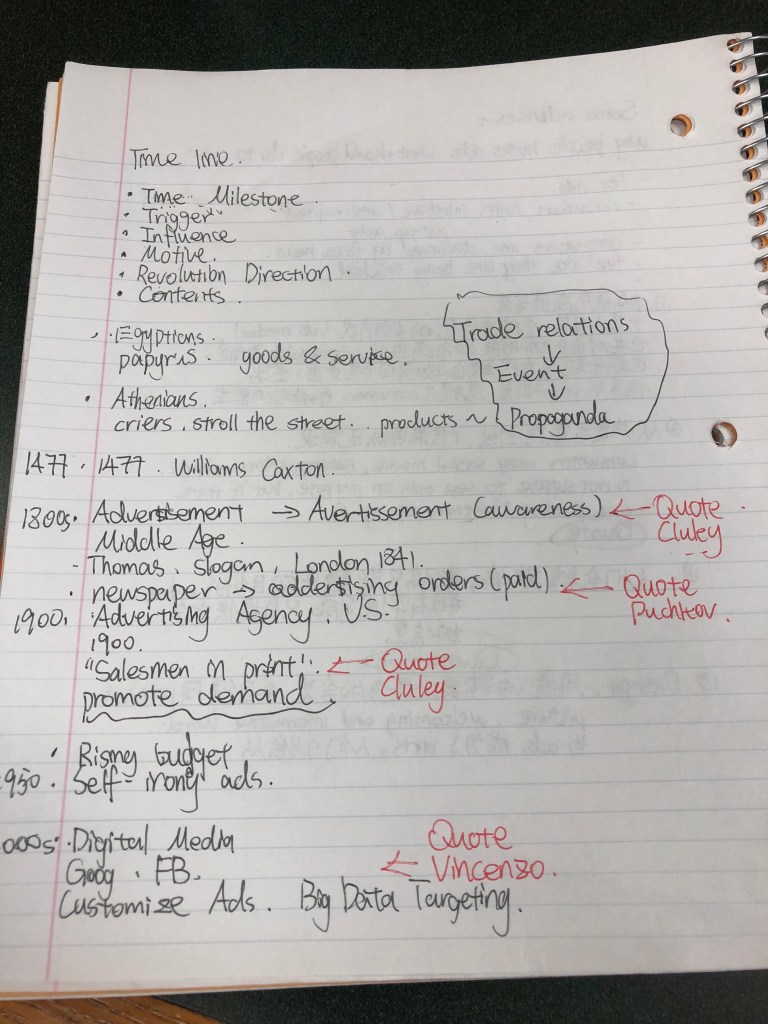
Advertising began its existence together with trade relations, and now it is difficult to imagine modern human life without this phenomenon. Starting with relatively primitive attempts to attract attention to a particular product or event in ancient times, the development of advertising has reached a completely new level of existence in our days. Modern advertising has become a global tool of influencing people’s minds to achieve certain goals of an advertiser: not only economic but also political and social.

The history of advertising goes back to ancient times. According to the Oxford English Dictionary, the word “advertising” came into use about 600 years ago from the French word “avertissement”, which is interpreted as “awareness” (Cluley, 2017). The first versions of advertising were found in ancient Egypt on papyrus. In Rome and Ancient Greece, advertising was made in an oral form. In the Middle Ages, advertising took both oral and written form, and Gutenberg’s invention of the print press in 1450 made print advertising more profitable and widespread (Puchkov, 2016). Thomas J. Barret became the pioneer of the modern advertising. Born in 1841 in London, he was one of the first people who applied a full advertising company when he worked for Pears Soaps. He used slogans as well as drawings in his advertising campaign. Inspired by his success, newspapers began to accept paid advertising orders, thus reducing the cost of sales and increasing production as well as their profits. Four years later, Volney Palmer organized the first US advertising agency, which was placed in Philadelphia. Benjamin Franklin is considered to be one of the forefathers of advertising in the U.S.; he founded the Pennsylvania Gazette, which had more advertising articles than any other newspaper of that time. In 1900, advertising became a profession.

The beginning of the XX century brought revolutionary changes to the approach of advertising. In 1904, in the office of the US advertising agency Lord and Thomas, a man who called himself John Kennedy had a conversation with an assistant executive director Albert Lasker. Lasker claimed that advertising was news. Kennedy objected and stated that modern advertising is not just news; it is “salesmanship in print” (Cluley, 2017, p. 6). It was a revolutionary but correct statement at that time. The mechanization of production formed a new lifestyle that forced an ordinary worker to live in large industrial cities. The man felt lost under the conditions of the new industrial revolution. These conditions became the core of a consumer society that was beneficial to producers. The culture of this type of society was shaped largely by advertising, which had a strong influence on the newly formed frustrated class of the population. Advertising not just paid attention to certain products as it used to be before, it reached people’s minds suggesting why, when, and under which circumstances some product was needed. The current way of life for one’ s benefit is primarily the result of advertising.

All above mentioned aspects as well as large territory and diversity of the population made the United States the heart of advertising. For example, in 1907, the annual advertising budget in the United States was 850 million dollars compared to 57.9 million in Britain (Vincenzo, 2016). In 1926, President Calvin Coolidge approved the contribution of advertising to shaping a new way of thinking. According to him, advertising created new needs for an ordinary American encouraging him or her to produce more and more, which was beneficial only to the state.  Over the next three decades, advertising has cemented a full-fledged way of thinking with a material object in the center of it. The adoption of such platforms as radio and television only increased the desire to purchase certain objects as well as showed the practice of proper care for this object. Although by 1950, the saturation of advertising has reached such a scale that its effectiveness began to fade and it did not last long. The new round of advertising – self-irony over the previous types of advertising revived the industry.

After the seventies, advertising budgets in the United States grew exponentially. In 1979, the U.S. advertising budget was 48.7 billion dollars, while in 1989 it increased to 124.7 billion (Vincenzo, 2016). Advertising was completely globalized in the 80s. Multinational corporations started investing more and more in different countries around the world. Such masters of advertising as Séguéla in France, Armando Testa and Emanuele Pirella in Italy, and Charles and Maurice Saatchi in England have formed outside the US.

The new stage of advertising development started when a human being was completely saturated with the material wealth and began to feel alienated from materialistic values. Mankind moved into a digital world, which provided a new type of non-material entertainment. This resulted in the filling of a new advertising niche by giants such as Facebook and Google (Vincenzo, 2016). Due to the popularity of the Internet, the customization of advertising acquired previously unthinkable proportions. This is connected with the fact that every day a person gives a huge amount of information about his or her thoughts, interests and preferences by using social networks. Based on that data, new advertising campaigns are built and placed on the same websites that the user visits. In 2016, investment in internet advertising exceeded investment in television for the first time in history, thus confirming once again changing the vector of modern advertising.

In conclusion, the history of advertising development was connected with the development of a civilized society. During antiquity and the Middle Ages, this type of activity had the form of announcements. In the 18th and 19th centuries, advertising took on more organized and complex forms. The 20th century is associated with a revolution in the purpose of advertising, which began to shape the world view of people. In the 21st century, advertising has taken on a new niche, the Internet, and continues to have a significant impact on the minds of humanity.

References

Are adverts doing what they are supposed to do? The connection between ads and culture

An ad, carried on any medium, is intended to promote a brand, a product or a company; engage current and potential customers to foster loyalty. However, adverts achieve just more than that; they are more than commercials for promoting brands. As an integral part of the mass media, have the potential to promote propagate particular ideologies and belief systems in popular culture and the society by extension. Also, I think ads can be high-efficiency channels that propagate positive energies to people. Also, such energies are from brands’ culture instead of from marketing plan.

Let me ask you a question first. If the brand name or logo is removed from an advert, would you be able to tell what brand the advert was promoting? I think the answers are obvious for most of ads. And, of course, it’s really difficult to leave the great obviousness and impression within few seconds clips. Then what’s the solution? Someone may say that companies can use attractive images and models. However, such solution can’t improve the recognition of certain brand once other brands are using same type of images. When I thought about this question. I was enlightened by Josh Sternberg’s blog post, ‘A Brand’s Cultural Relevance Is Almost as Important as a Strong Image, Study Finds‘, in which he suggested that the brands should align themselves with some existed cause or issues. I think brands should involve what they are believing in into the ads, and such beliefs are so called brand cultures. When consumers’ voices and opinions echo from the ads, they know that they are sharing some similarities with the brand, and they will then get into learn more about the brand.  

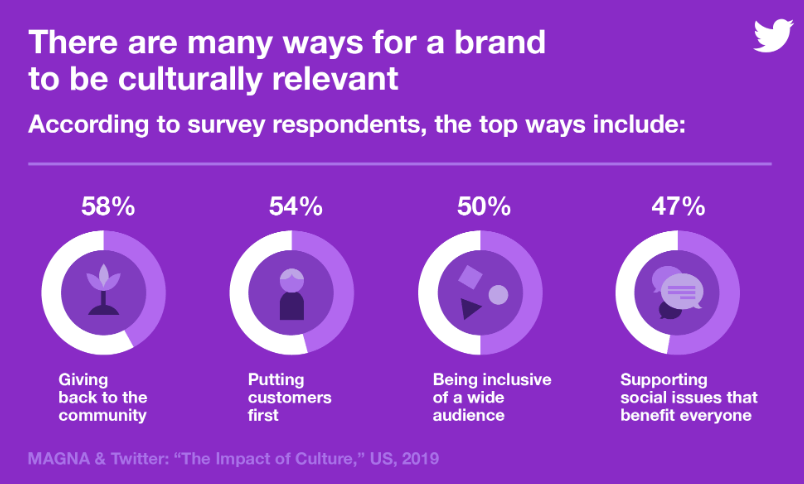
Is that enough? Nah! I think bringing brand culture into ads is the first step. Then what’s next? I believe is engaging in culture. Culture is formed by community, certain group of people. Products are producing for people. So it’s necessary for brands to engage in culture by the bridge, advertisements. Giving back to the community; putting customers first; being inclusive of a wide audience; supporting social issues that benefit everyone — four top ways for a brand to be culturally relevant reported by E.J. Samson’ study. All these solutions are basing on one theory — brands should listen to customers. Learning customers’ culture is a huge need for brands. If brands can become part of the culture, they have more opportunities to deepen their relevance and connection with customers. The ads, as the most prevalent channel to people’s lives, should be the one that execute such duty, helping brands to become part of the culture.

Satisfying these ‘prerequisites’, the ads maybe closer to success. Information is important, but the belief and culture are even more valuable and memorable for consumers. ‘Just do it’, the slogan from Nike is always encouraging me to make progress and work harder. It’s not only a slogan but a belief that is brought to my mind by ads.

Room for Ads Improvements: Why Customers Are Holding Negative Attitudes to Ads?

Advertising is the one of the most efficient ways to bring product’s information to the consumers. As the development of society, advertising is becoming a big portion of marketing management, and people are giving more and more attention on ads. Also, advertising is now a crucial representative of companies’ images and playing an essential role of expanding markets. However, as advertisements rapid growth, consumers are gradually tired of the forms of advertising. What’s more, some companies are producing ads only to make a profit Instead of to optimize consumers’ experience.

‘Consumer like having the perception that they are in control, and when a media platform disrupts that perception, its persuasive effectiveness is diminished’. (Scott Yoder, 2017) Personally, the real ads should focus on our willingness and demands. Nowadays, we are frequently using social media and visiting web pages. When the pop-up ads come up, they will be so annoying that we may close the windows immediately since they are preventing us from reading contents. Then pop-up ads will not only loss its effectiveness but also make viewer resented, which is a lose-lose situation. Therefore, the consumers will receive more respect if the number of pop-up ads can be minimized.

Another reason people scathing toward ads may be caused by fake or ambiguous information on ads. Some companies fabricate or blur the information. Even though this behavior may gain concern shortly, consumers will realize the fraud and, eventually, lose trust of ads and brands. ‘According to a joint report between British newspaper, Trinity Mirror and research firm, Ipsos Mori, across the whole U.K, 42 percent of adults distrust brands, and 69 percent distrust online advertising. Just over a third of people said they trust brands less than they used to, and 43 percent admitted they trust advertising less, according to the same report.’ (Jessica Davies, 2017) Even though the research may be only reported from certain area and people, it’s convincing enough that ads are getting less trust and acceptance among consumers, and the tendency may consequentially depart ads from its original purpose, bringing trustful information for customers.

I think the design of ads maybe another essential factor for the effectiveness. As we are getting our sense of beauty, we maybe more welcoming for the ads that fitting our ‘tastes’. For example, I prefer apple’s advertisement in which presenting polished image, simple words and attractive products. However, there are tons of ads having too many words with a rough background picture, and I would absolutely ignore those. In order to boost the effectiveness of ads, I think the companies are responsible for improving the design of ads. Personally, I suggest the advertising department give more attention on what styles are target consumers looking for, such as color, format and catchword. Presenting advertisements in the artwork may be a direction that companies can develop to.

As lifelong consumers, we may have lot of complains and suggestions for the ‘bad’ ads, and we also have right to talk about that because the ads are made for us. Watching a creative, informative and attractive ads is needed for consumers, and it’s also a goal that companies should adhere to. 

Reference

  • Scott Yoder, 2017, The Evolution of Advertising: From What We Hate to What We Can’t Resist
  • Jessica Davies, 2017, The Global State of Consumer Trust in Advertising in 5 Charts

Another Face of the Beauty Ads: Where is the inspiration from?

Nowadays, for us, toxic ads may somehow difficult to avoid due to the freedom of sharing information and the utility of big data. But we can still explore great hopes from some remarkable ads. Recently, we can’t deny that more and more beauty ads are making great progress: better presentation, credible instruction, and welcoming attitudes to customers. Also, I think such development is not only taken place in the field of beauty ads but can be in whole advertisement industry. I made up my mind presenting some great examples of beauty ads because I assure that ads are those can bring great hope to customers.

‘De Pelsmacker, Dedock, and Geuens (1998) identified three ad dimensions: emotional content, informational content, and format. De Pelsmacker and colleagues posited that these three dimensions influence both affective and cognitive response to ads that, in turn, affect brand attitude, which then influences purchase intentions.’Yvonee Terry-Mcelrath, 2006). There were days I was looking at myself in the mirror and thinking what I really look likes. I thought the mirror may tell me, but I still didn’t believe the person in the mirror because I look at the projection by my eyes, which are connected to my mind and depend on my intuition. Then I found that others’ words and impression on me can be a measurement of the ‘real’ me. In recent days, individuals receive approximately 10,000 ads per day, and they are subtly influencing our self-identities and self-cognition since we can’t prevent ourselves from receiving the information from ads.

Beauty advertisement, as the one of the highest viewing rate ads, is an essential factor that shape viewers’ self-cognition and confidence. When customers saw a beauty advertisement that presents how the products turning a bad skin condition into good ones, customers may feel that they are probably in bad skin condition even they aren’t. ‘Ads for beauty-enhancing products seem to make consumers feel that their current attractiveness levels are different from what they would ideally be.’(University of Chicago Press Journals, 2010) I might agree with this when I wrote previous post. However, when I think this aspect from another perspective, I find that the customers may just want their skin to be better, and the ads may not damage consumers’ self-esteem in order to sell the products. There is still a controversy behind the fact, and such confliction enlighten me to think of the way that beauty companied present their products.

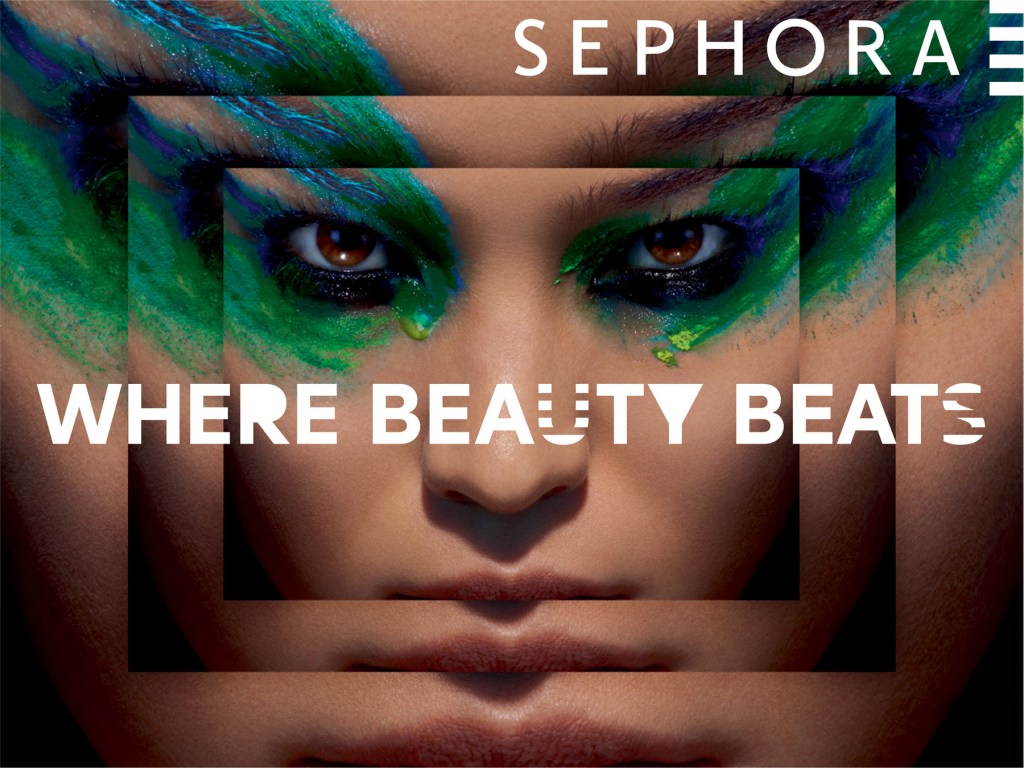
When individuals receive information from ads, individuals bring out distinctive understanding basing on personal situations. And that’s where the negative influence majorly coming from. However, there are ways to minimize such misunderstanding and misleading effect. In the ads from Kimono, the clothing brand established by Kim Kardashian, there are models with different statures wearing same products on the scene. Encouraging people of all body types to wear same product, Kimono’s ads bring respect and inspiration to the consumers who used to afraid of wearing such product. Additionally, Sephora, the multinational chain of beauty store, is using a conversational way to advertise their product. When the ads pop up, the ads viewers are allowed to type in the ads to talk about how they feel about their skin condition, and the ads may give a summary of some products relating to certain conditions. These kinds of ads do grab my attention, and I think the companies are playing a role of listener instead of seller to the consumers. It can not only satisfy the true demands of customers but make profit for the company.

I’m writing this post to bring information that there are top companies are doing good jobs in advertising, showing respect and understanding to us. When we confront some aspects, we may see both pros and cons of them before we make the conclusion. Hopefully the examples I gave may bring you novel judgements toward the advertisement.

References

  • University of Chicago Press Journals (2010). How do beauty product ads affect consumer self esteem and purchasing?
  • Yvonne Terry-mcelrath, Melanie Wakefield, Erin Ruel, George l. Balch, Sherry Emery, Glen Szczypka, Katherine Clegg-Smith, Brian Flay (2006). The Effect of Antismoking Advertisement Executional Characteristics on Youth Comprehension, Appraisal, Recall, and Engagement

Beauty Advertising: Why Do You Need to Keep Your Adolescent Child Off the Media?

Beauty advertising is a monster living among humans. For decades now, beauty products companies have made fortunes out of mainstream advertising. It is a pivot to their marketing campaigns as it makes their products more visible to the target market. They send messages through the media to the target audience to woo their long-term patronage. The consumers have maintained their loyalty to the brands that appeal to them for a straightforward reason; the products make them achieve the “perfect body.” At least that’s how the advertising messages recommend.

However, humanity has turned a blind eye on the ramification of beauty advertising. Various credible researches done previously, have pointed out that beauty advertising is silently killing the youth. Children are often vulnerable to negative advertising. In their age, they have not developed the appropriate analytical skills to enable them to overcome negative advertising. Beauty advertising sets the threshold for beauty and body image. This fact perhaps emphasizes n the ability of the advertising industry to turn mundane objects into products of desire.

Advertising messages have inadvertently controlled the way people think and imagine. According to the University of Chicago Press Journal, after being exposed to the advertising messages of beauty enhancements, consumers were doomed to feel about themselves more than they previously saw those products out of their advertisements. This observation is alarming in every respect (Benowitz-Fredericks et al. 2012). Expressed, upon being exposed to these messages, the audience was bound to think of themselves negatively in a way that only the products could make them achieve a perfect body.

This very wrong in every sense. Adolescents are the most adversely affected by this reckless advertising. Other renowned researches have credibly established that beauty advertising has profound effects on teenagers more so adolescents. Slater et al. (2012) corroborate that beauty advertising reduced their self-assurance. Such messages set unrealistic standards as well as expectations on them through the application of idealized models. Such an observation indicates that without proper guidance, teens are likely to sink into depression as a result of these messages. Regardless of whether these teenagers have a negative perspective about their bodies, these messages have been found to aggravate the situation.

Beauty is exhibited in a way that triggers negative thinking in the target audience, mostly teenagers, in instances when they do not achieve the perfect body (Benowitz-Fredericks et al. 2012). They present images of models that are difficult to replicate. In cases where the consumer fails to attain such images, they become depressed and see themselves as inappropriate. Important to note is the fact that many of these models are below the appropriate net body weight; thus, trying to emulate them will result in severe health complications. In other words, women are encouraged to lead unhealthy lives to achieve the portrayed image.

Using these observations, it is understandable why parents are mostly urged to guide their young ones on how they consumer advertising messages. However, that alone is not enough remedy. It is worrying how these companies have been given the leeway to lie to the consumers are continue to make billions of dollars while they take a massive toll on the consumers. With this in mind, as a responsible parent, it is good to keep your children off the media for the meantime.

References

  • Benowitz-Fredericks, C. A., Garcia, K., Massey, M., Vasagar, B., & Borzekowski, D. L. (2012). Body image, eating disorders, and the relationship to adolescent media use. Pediatric Clinics of North America, 59(3), 693.
  • Slater, A., Tiggemann, M., Hawkins, K., & Werchon, D. (2012). Just one click: A content analysis of advertisements on teen web sites. Journal of Adolescent Health, 50(4), 339-345.

Design a site like this with WordPress.com
Get started